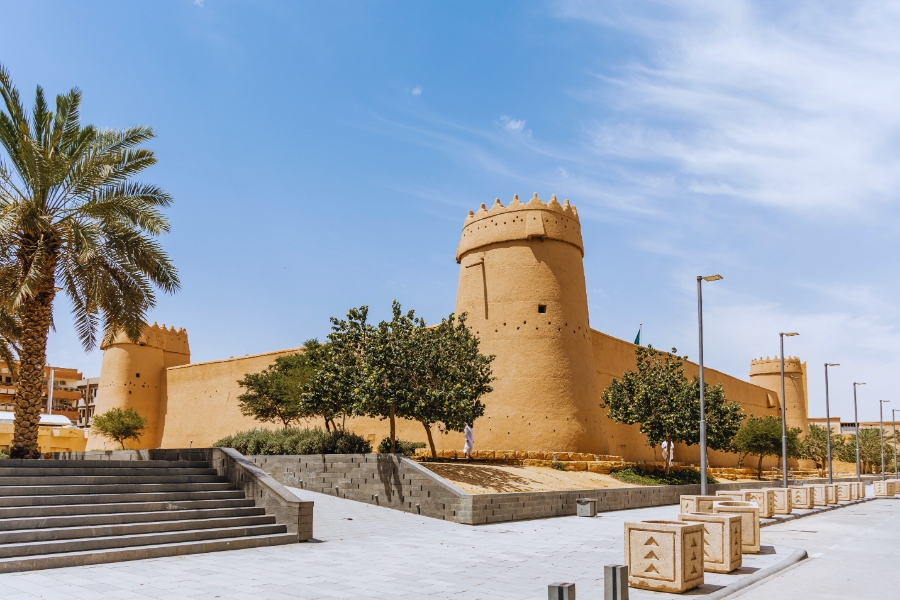
Masmak Fort is a historic clay and mudbrick fort that has witnessed the birth of modern Saudi Arabia. History lovers are drawn here because the fort was the stage for a daring battle in 1902 that paved the way for Saudi Arabia’s unification. Beyond its past, Masmak Fort is one of the most important Riyadh heritage sites, preserved as a museum to educate visitors about the Kingdom’s roots.
Renting a car in Riyadh makes it easy to reach Masmak Fort and explore the surrounding historic area. Its thick mud walls, palm-log watchtowers, and antique wooden gate immediately transport you to the 19th-century Arabian Peninsula. In simple terms, visiting Masmak Fort is like stepping back in time. This Masmak Fort travel guide will explore why the fort is a must-visit.
Masmak Fort is a museum that features fascinating exhibits that bring history to life. You’ll find plenty to marvel at inside the fort’s thick walls. The curators have filled the rooms with artifacts. These include swords and rifles used in the famous 1902 battle, old maps, and photographs that show what Riyadh looked like over 100 years ago. In addition, the museum features interactive displays, audiovisual presentations, and detailed models.
One of the highlights of visiting the Masmak Fort museum is seeing artifacts from the era of King Abdulaziz and earlier. In the primary exhibition hall, you’ll encounter an array of weapons and war equipment used during the Battle of Riyadh in 1902. Display cases hold rusty swords, spears, and daggers alongside old rifles and pistols. Aside from these, you’ll see traditional military uniforms from the early 20th century, including the kinds of cloaks and ammunition belts for fighters. This section also showcases some personal items belonging to warriors of that time.
There are extensive maps and documents on display. Large maps of the ancient Arabian Peninsula reveal how borders and tribal territories appeared in the past. There are also old survey maps and sketches of Riyadh. You can see the city’s layout in the late 1800s, which was a small walled town compared to today’s metropolis.
Historic documents, such as correspondence and treaties, are exhibited to highlight key events in Saudi unification. For instance, you might find a copy of a letter from Ibn Saud to tribal leaders. Photographs or realistic drawings from the early 1900s line some walls, including portraits of King Abdulaziz and his companions.
Aside from military history, there’s a room that showcases the everyday life and culture of old Najd. Here, you can see artifacts of civilian life. There are tools used in traditional agriculture, such as wooden ploughs or water skins from the oases.
Also, there are household items such as cooking pots, coffee mortars, and Bedouin weaving tools, alongside ornaments and jewelry that people in those days used. One striking display is the “Bayt al-Mal” room setup, which shows how collected grains or coins were stored as taxes in kind.
Masmak Fort museum has modern ways of storytelling to complement the ancient artifacts. As you go through the halls, you’ll find several interactive and multimedia displays. One of the rooms features a large diorama or model of old Riyadh and Masmak Fort, showing the city’s layout circa 1902. Often, a light or projection is used on this model to reenact the route King Abdulaziz took during the raid.
There’s also a mini theatre or screening room inside the museum. Here, visitors can watch a short documentary or re-enactment video about the Battle of Riyadh and the unification of Saudi Arabia. The film uses historical photographs, expert commentary, and dramatized scenes to tell the story. Watch this 10- to 15-minute video if available, as it effectively summarises the importance of Masmak in a lively way.
In some areas, you might find touchscreen displays or kiosks that allow you to explore digital archives. The museum also has curated theme halls. Notable ones include the “Al-Masmak Conquest Hall”, the “Historical Riyadh Hall”, and the “Pioneers Hall”. In the Al-Masmak Conquest Hall, a combination of life-sized exhibits and multimedia tells the story of the fort’s capture.
Meanwhile, the Historical Riyadh Hall might use comparative displays of old and new, such as a panoramic photograph of 1910s Riyadh contrasted with a recent one. The Pioneers Hall usually honors the people involved in unification, so expect to see old black-and-white photos of King Abdulaziz’s comrades and family, accompanied by descriptive panels about their roles. One particularly immersive experience is a holographic or audio display where you stand in the majlis room and hear a narration as if King Abdulaziz were recalling the night of the attack.
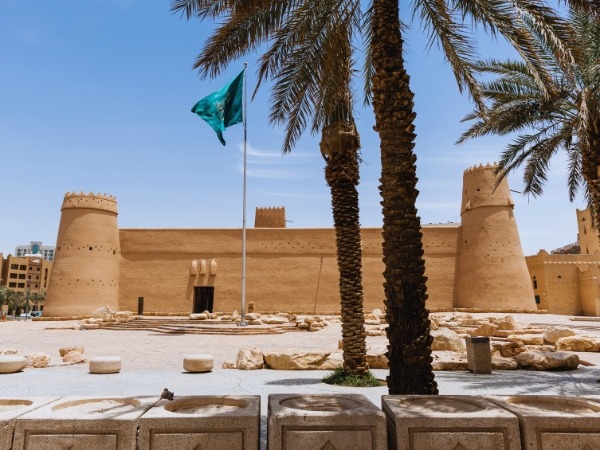
Practical information is key to planning your visit to Masmak Fort. In this section, we’ll cover the location of Masmak Fort, how to reach it, and other essential information.
Masmak Fort is situated in the historic core of Riyadh, in a district called Al-Dirah (Ad-Dirah), which is the old downtown area. The fort’s exact location is along Al Thumairi Street, just next to the Grand Mosque and the old Souq Al-Zal marketplace. If you look for “Qasr Al-Masmak” or Masmak Palace on a map, you’ll find it near Al-Hukm Palace and a short walk from “Chop Chop Square” (Deera Square).
Getting to Masmak is relatively easy. If you are coming from the Kingdom Centre or the Al Faisaliah Tower, it’s about a 15 to 20-minute drive to the fort, which is around 6 to 7 kilometres from the city center.
If you’re flying into Riyadh and heading straight to Masmak, one convenient option is to avail a car hire at King Khalid International Airport Terminal. The airport has several car rental companies in its terminals, allowing you to pick up a vehicle upon arrival. Driving in Riyadh is the fastest way to get around, and with your own car, you can easily navigate to Masmak Fort and other sites.
The fort has parking areas nearby, especially around the Souq. If you drive, be prepared for city traffic. Road signs to tourist attractions, such as Masmak, are usually displayed in Arabic and English. Once you arrive in the Al-Dirah area, you’ll recognise Masmak by its sand-coloured fortified walls and round towers rising above the low-rise surroundings.
Masmak Fort’s museum is open every day, but hours differ during the week. The typical opening hours are from 8 AM to 9 PM, Monday through Thursday, with a midday break, and modified timings on weekends. On Fridays, the fort is usually closed in the morning and opens in the late afternoon from 4 PM to 8 PM, as Friday mornings are prayer times. On Saturdays, it is open from 9 AM to 8 PM.
Always double-check the current schedule before you go, as timings can change during Ramadan or holidays. If you arrive midday, you may find the doors closed for a siesta from around noon to 4 PM on certain days. Plan to visit in the morning or after 4 PM if possible.
Entry to Masmak Fort is free. This makes it an accessible attraction, especially for families or travellers on a budget. When you arrive, you’ll likely enter through a visitor reception where you'll sign a guestbook or note your nationality for their records. There’s no formal dress code posted, but Masmak Fort is a cultural site in a conservative country. Visitors should dress modestly out of respect.
Riyadh has a desert climate, characterised by extremely hot summers and pleasantly cool winters. Masmak Fort has indoor and outdoor areas. The central courtyard is open-air, and you’ll likely stroll a bit outside around the fort.
The best time to visit Masmak Fort is during the cooler months, from November to March. During this period, daytime temperatures in Riyadh range from about 15°C to 25°C, which is ideal for walking around comfortably. In December and January, mornings can even be chilly (around 10°C), but this is easily managed with a light jacket.
Conversely, the summer months from May to September are extremely hot, with daytime highs often soaring above 42°C (108°F). Riyadh in summer is not very pedestrian-friendly due to the intense sun and heat. If you visit Riyadh during the summer, plan your visit to Masmak for early morning or late evening, when temperatures are cooler.
Masmak Fort is a cornerstone of Saudi Arabia’s national story. History lovers will appreciate the depth of information, interactive displays, and authentic artifacts that make a visit both educational and memorable. Thanks to its central location and free entry, Masmak Fort is an accessible and rewarding stop for all travellers.
Rent a car in Riyadh with Final Rentals to reach the fort easily, manage your time, and explore nearby cultural landmarks. With Final Rentals, booking a car online is fast and simple. Select King Khalid International Airport as your pickup location, enter your travel dates, and choose a vehicle for your trip. Book and manage your car rental at any time. Download the Final Rentals app on Google Play and the App Store.